


This week has seen incredible heat for England and Wales with a new June record high for the UK. There have been several days with Extreme Heat warnings from the Met Office and gruelling nights giving little respite. The hot and humid air from western Europe also pushed north into Northern Ireland and Scotland.
As temperatures moved into the 30s Celsius just after midsummer, there were hours of available direct sunshine heating the land, a flow of unusually hot air from France, high pressure nearby with slowly descending air just getting hotter and hotter. After two record breaking heatwaves, one in May and this in June, what might the “height of summer” bring in an El Nino year?
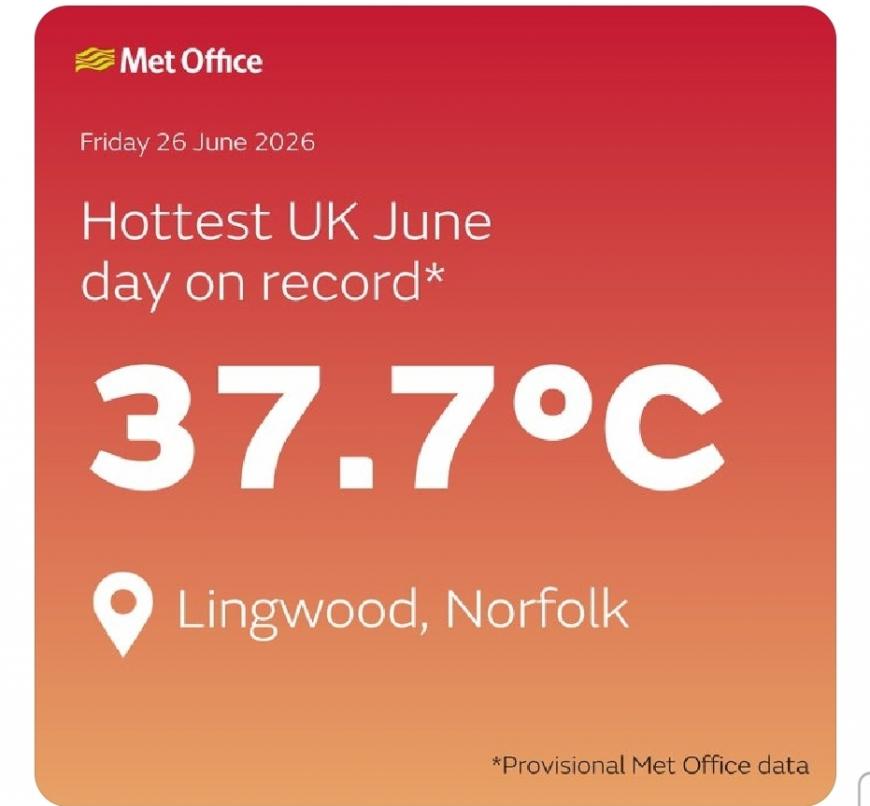
The June temperature record for the UK has stood at 35.6C since 1976; fifty years since a major summer heatwave that remains in many peoples minds. It has been broken on three consecutive days with provisional values of 36.1C at Gosport, Hampshire on Wednesday, 36.7C at Merryfield, Somerset and finally 37.3C Santon Downham, Suffolk by Friday 26th June. The Friday maximum has now been updated* with 37.7C at Lingwood, Norfolk. Many other sites rose above the previous record in this hot and humid event.
Values on one day can be surpassed as the 09Z observations come in from sites the next day, that are only visited every 24 hours, and other enclosures that are visited less frequently. All record values will undergo official verification.
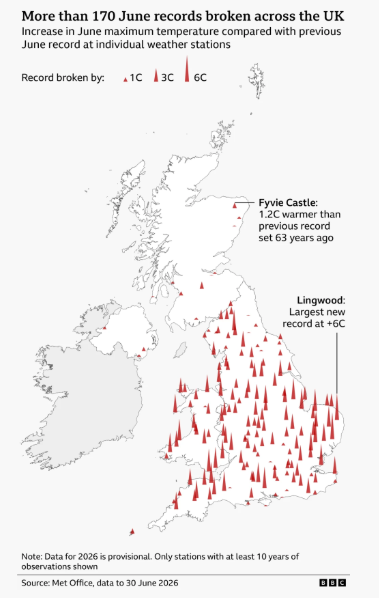
Before this week, the June month records for the home nations were England 35.6C, Wales 33.7C, Scotland 32.3C and Northern Ireland 30.8C.
The England (and UK) record has now been smashed by over 2 degrees. Wales has a new June record of 35.9C at Bute Park in Cardiff which is another alarming leap. The Northern Ireland record was equalled at Castlederg, again with 30.8C.
Scotland did not pass its high temperature record, but rose to 32.2C in Threave with heatwave conditions.
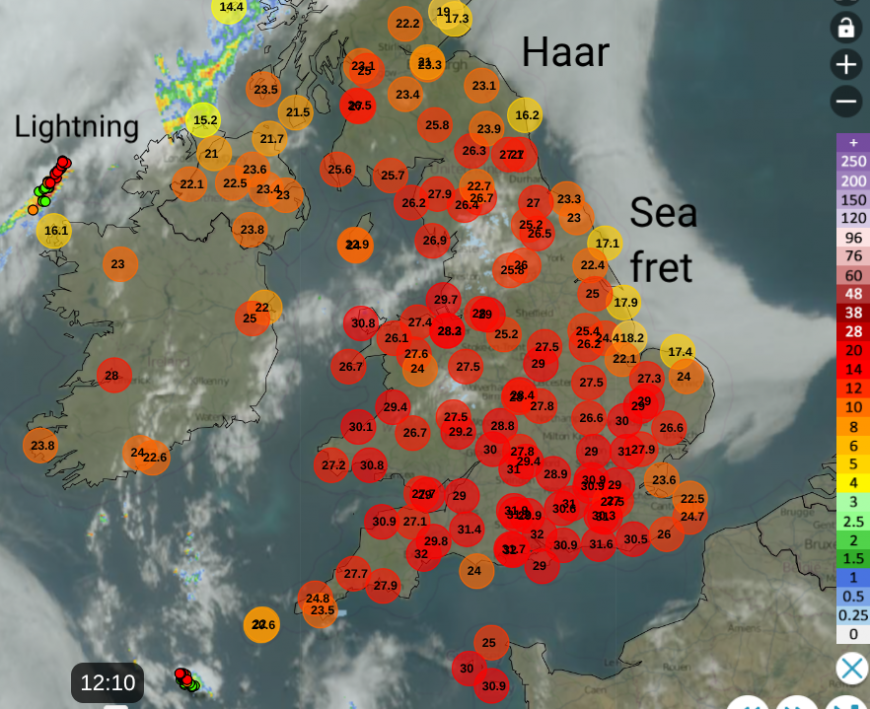
Thursday 25th June Netweather Radar
Tropical nights
Bute Park in Cardiff, set the night-time highest minimum temperature record for Wales, and for the UK, with 23.5C reported overnight from Wednesday into Thursday. England also looks to have set a new highest minimum temperature record for June on the same night, with 23.0°C in Plymouth.
A Tropical Night is when the minimum temperature does not fall below 20C overnight,
Northern Ireland has provisionally broken its highest minimum temperature record overnight 24th into 25th, with a 19.1C low at Murlough.
UK historic June heatwave temperature watch
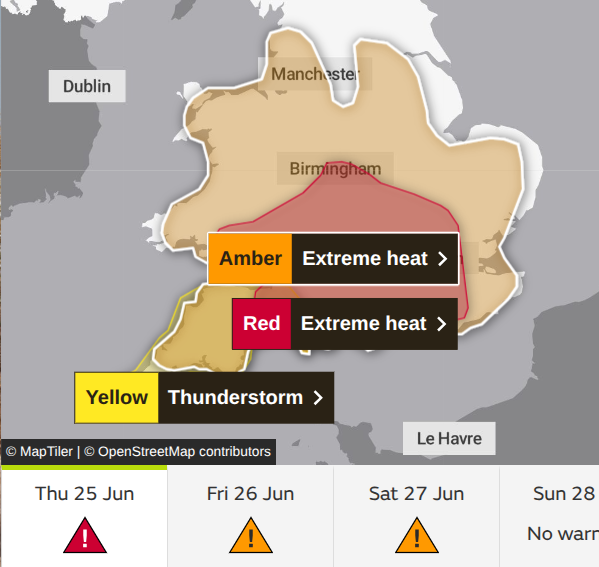
Extreme Heat warnings from UK Met Office on Thursday 25th June with additional Thunderstorm warning
Schools closed, or only opened til lunchtime. Train passengers were asked to only travel if their journeys were essential. Many didn’t want to get on a hot train unless their offices were air conditioned at the end of the journey. Events and activities were cancelled as the heat continued. Southeast Water has introduced a hospepipe ban (TUB) in Kent due to sustained pressure.
“Due to sustained high temperatures and near record levels of demand for treated drinking water across Kent, we have made the difficult but necessary decision to introduce a Temporary Use Ban (hosepipe restrictions) for customers in our Kent region.” SE Water
Even with some heavy rain in thunderstorms, the evaporation from the land over this week will be adding to water companies concerns. And the drying will also worry Fire & Rescue teams with an increased risk of wildfires spreading, when no-one would want to be fire-fighting in this heat.
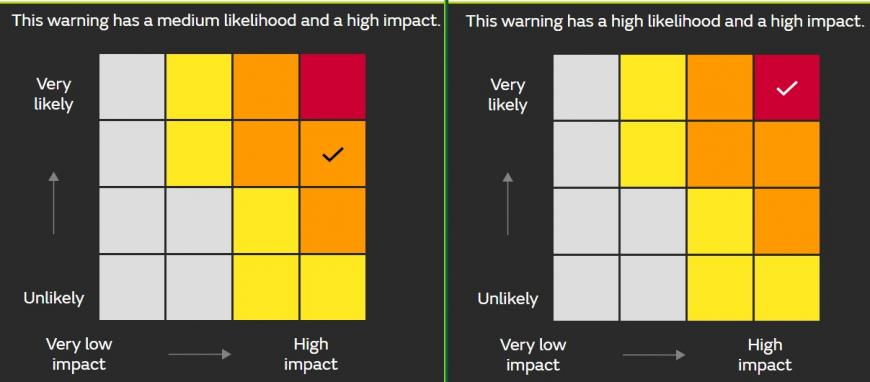
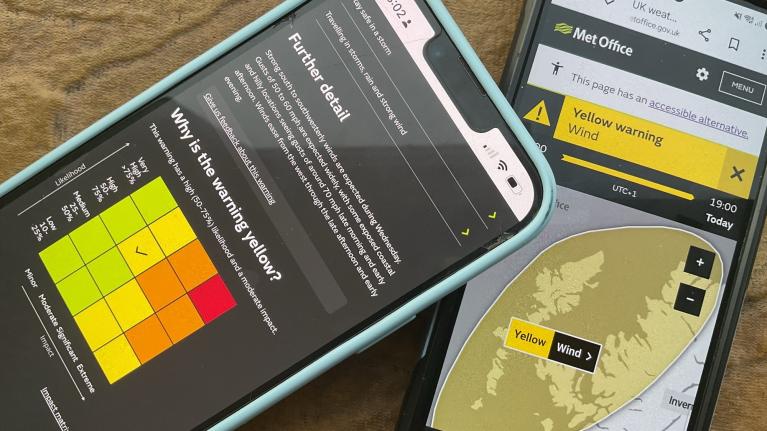
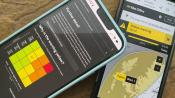
There is some difficulty in this Extreme Heat setup about understanding the difference between the Red and Amber areas. Both warnings relate to High Impact (EXTREME) weather conditions. The ticks on the matrices are both in that column. The difference (and so the change of colour) relates to the Likelihood of these High Impacts occurring. The area in central southern Britain is VERY LIKELY (>75%) to see these extreme conditions. The wider area, covering more of England and Wales is LIKELY (50-75%) to see these extreme conditions. It is not just that one area will be much hotter than the other.
Visually, due to "red hot" connotations, this may not have quite worked for the general public, although the overall warning of severe weather and extreme heat has been clearly communicated.
Extreme heat warnings - impacts and discussion
There is a growing strain on energy companies as the demand for electricity grows in this heat. Air-conditioning systems and fans are in full use. You may have heard from your energy company to use less energy for an hour or so in a 'saver session'.
Not only has it been hot and humid there are now moderate levels of Ozone pollution over England. "Avoiding exercise outdoors in the afternoon can reduce individual exposure to ozone." DEFRA. Some of this has been transported from mainland Europe but heat and strong sunlight leads to local production.
Dr James Weber, at the University of Reading "This week ozone breached World Health Organisation safety levels at most [UK government] air pollution monitoring sites...primarily in southern England...“Ozone is harmful to breathe, particularly for older people, children and those who are medically vulnerable. This can exacerbate the other health issues caused by heatwaves.”
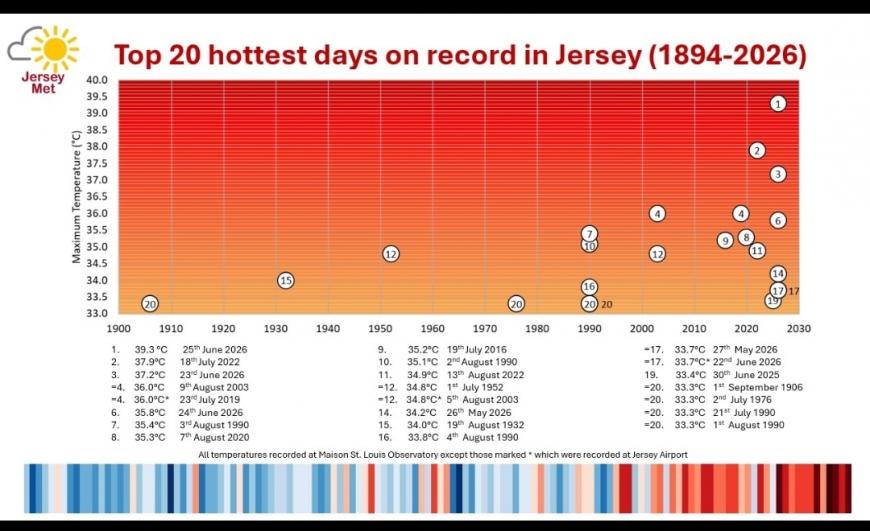
In the Channel Islands on the 25th, Jersey Met announced a new all time temperatures record of 39.3C at the Maison St. Louis Observatory, Jersey, (records back to 1894). The previous highest recorded temperature on the island of 37.9°C was 18th July 2022.
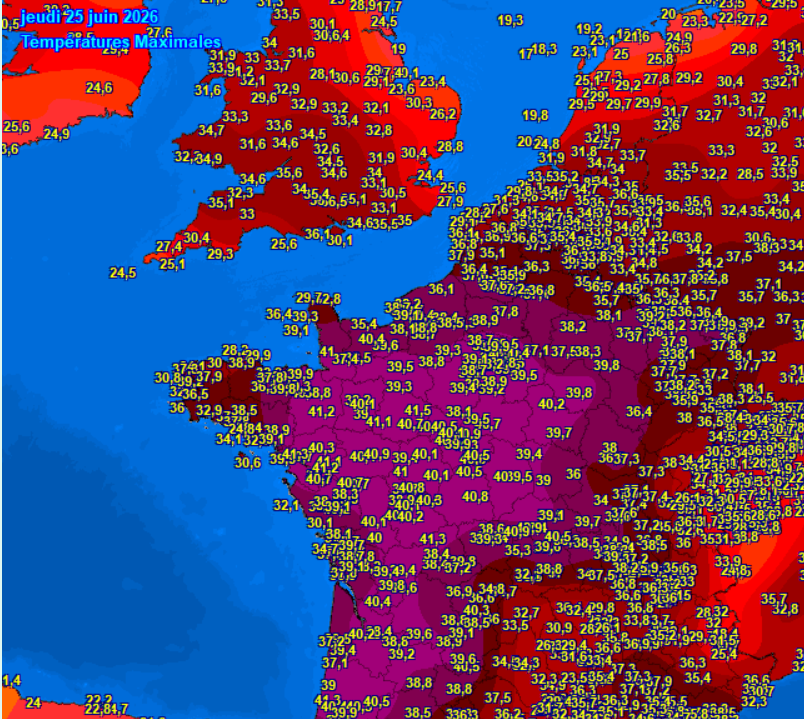
France also saw its hottest day on record across the nation, within an exceptional and deadly heatwave. Temperatures moved into the low 40s Celsius with many areas spending days with red heat warnings.
“France recorded its hottest day on record on 24 June - beating the record set the previous day - with an average national temperature of 30.0° Celsius, above previous records set in July 2019 and August 2003” said Metéo-France. Overnight temperatures also set a new nationwide record of 22 °C. Authorities warned of a high risk of wildfires amid a worsening drought, stopped alcohol sales, seen numerous water tragedies and a huge strain on infrastructure, health services and people’s lives.
Spain recorded its hottest June days on record on 23rd and 24th June as temperatures rose above 40C. AEMET announced a location record for June for the city of Bilbao, 42.7°C. Germany had many red warnings for heat as the Netherlands issued their first Red extreme heat alerts on 26th June. Switzerland saw a new June record of 38C for Basel in the north were there had also been many red heat warnings.
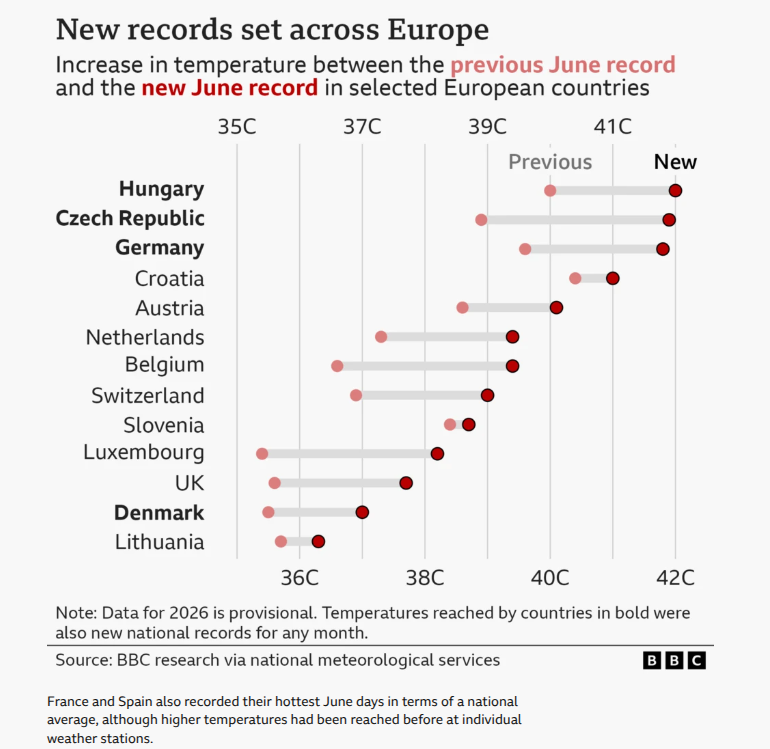
Astonishing scope of records broken across Europe, often by several degrees (graphic BBC)
It is thought that at least 101 million Europeans sweltered in temperatures of over 35C on Thursday 25th. Our world is heating.
"Climate change, caused by burning coal, oil and gas along with other human activities such as deforestation, has made this week's heatwave hotter and more likely" Liz Bentley, Chief Executive, Royal Meteorological Society, with climate scientists actively working on these issues
“The evidence is clear: climate change is happening, and the major cause is burning fossil fuels like oil, gas and coal.”
European heatwave June 2026 thread
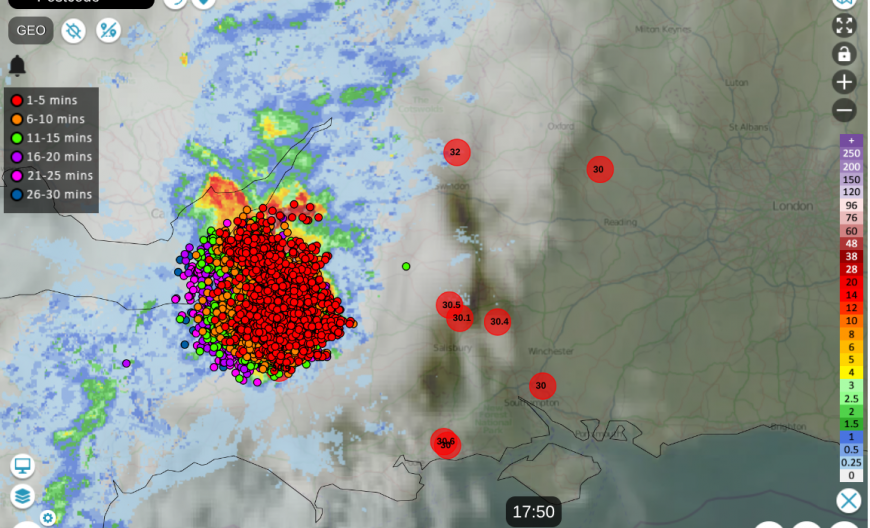
Netweather Radar -SW Britain MCS with thousands of lightning strikes on Monday 22nd June evening
There were thunderstorms, including large Mesoscale Convective systems (MCS) with thousands of lightning strikes and torrential rain. One developed on Monday evening over SW England, passing over Glastonbury and near Bristol in the evening, where a house was set on fire by a lightning strike. Storms woke up Londoners early on Tuesday morning with another stunning lightning show.
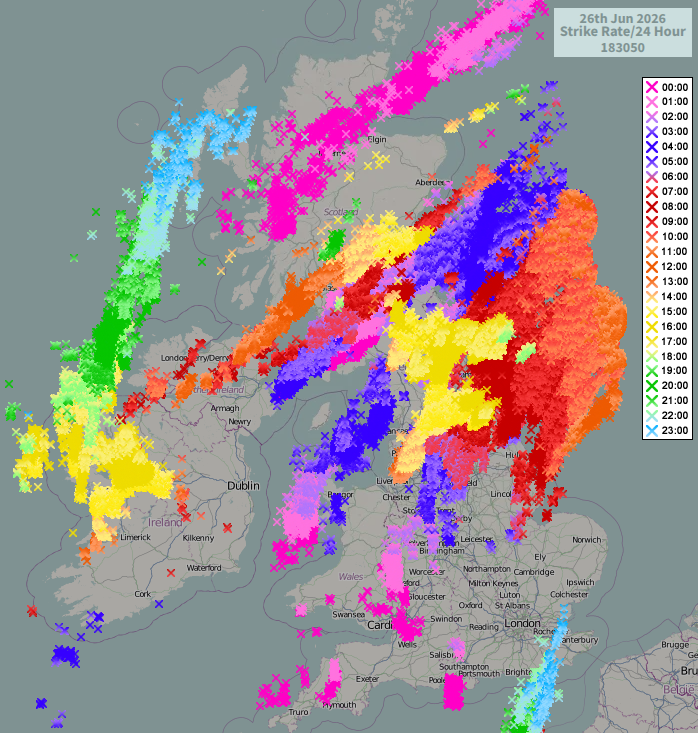
Early morning lightning strikes over Scotland (purple) with mid afternoon sferics (yellow) 24 hours Friday 26th
By Thursday evening, there was frequent lightning, large hail and gusty winds over NW Scotland before another system developed over southern Scotland heading for Edinburgh in the small hours and lighting up the skies of SE Scotland. There was incessant Cloud-to-Cloud (CC) lightning with many Cloud-to-Ground (CG) strikes, resulting in another house setting on fire in Midlothian.
This week in June has been record breaking for the UK and will be remembered as an intense heat event for early summer.
Loading recent activity...