


The UK will see a partial solar eclipse on Wednesday evening, 12th August, as totality takes place over Spain, Portugal and Iceland. Across a swathe of mainland Spain, the Balearic Islands, northern Portugal and western Iceland, 100% of the Sun will be obscured by the Moon passing between the Sun and Earth. For those under the full shadow of the Moon, there will be a minute to a minute and a half of totality, a rare incredible occasion.
For the UK, we will be at the edge of this process, so some sunlight will continue to reach us. With a gradual covering occurring in the hour before the peak just after 7pm, there will be around 90 to 95% of the Sun covered between 19:02 and 19:16. The Sun is so strong that even with over 90% blocked it is still dangerous to look at directly. You may just notice a eerie dimming of the light around you at the peak.
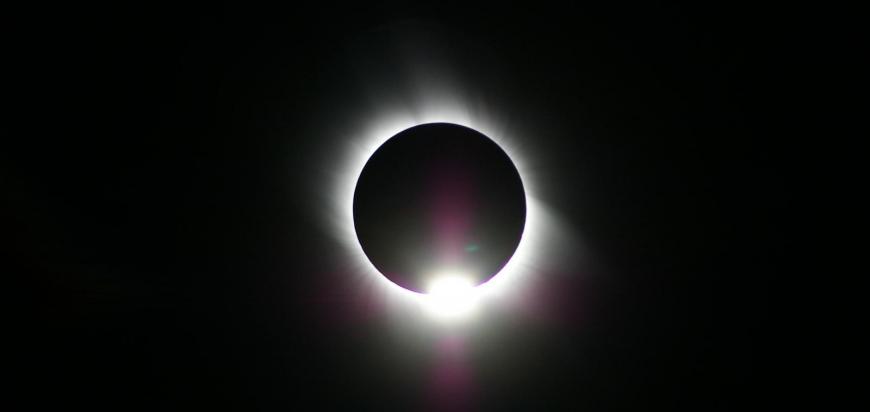
This is the first total solar eclipse visible over mainland Europe in 27 years.
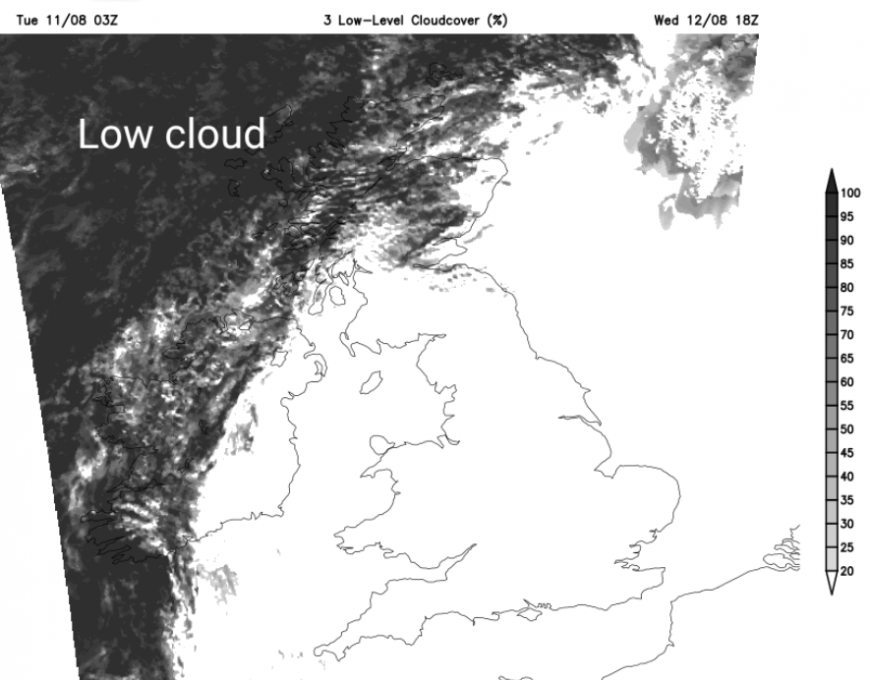
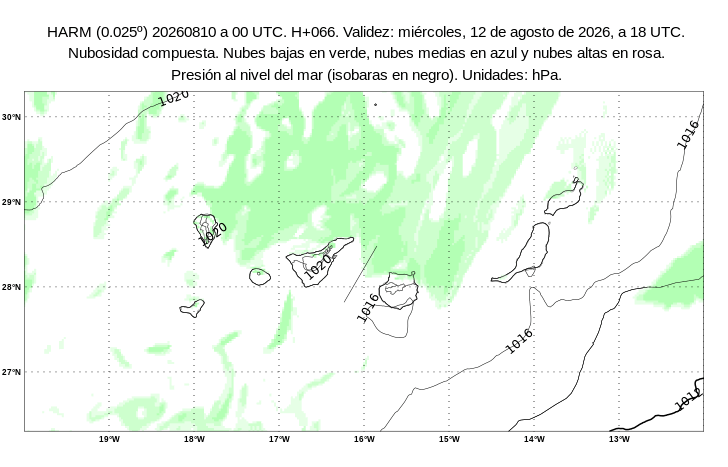
The cloud cover charts for 18Z on the 10th will give some idea of how the skies will be. However, low cloud will be annoying but could still give some gaps depending on its thickness and the wind strength. Those who travelled to Cornwall in 1999 for totality may remember the frustration or joy of this.
High cloud could be thin enough to still see the sun through. Medium level cloud can vary from the thick continuous blanket of altostratus to the banded and undulating patterns of stratocumulus, which would have gaps in it.
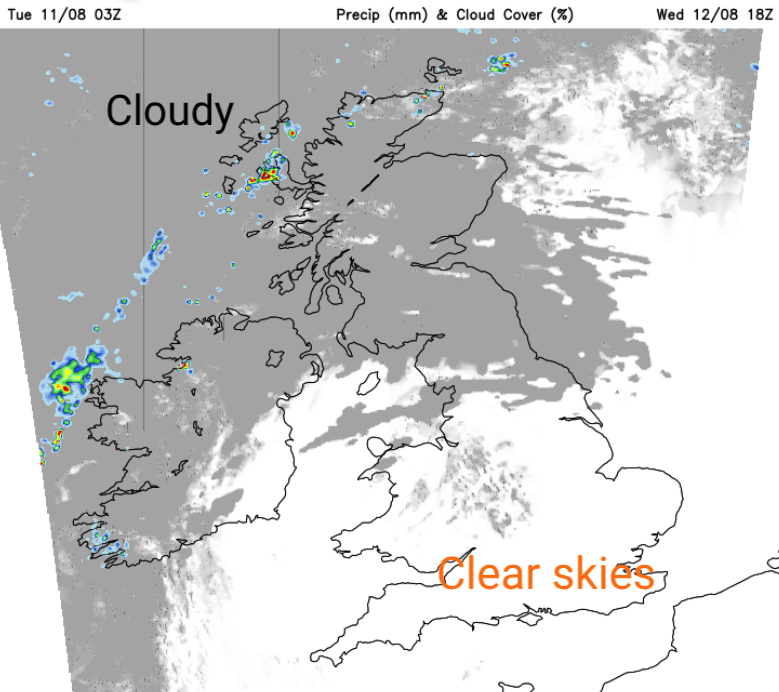
UK forecast for the partial eclipse
For much of the UK there will be clear skies and plenty of evening sunshine after a very warm day. Set an alarm on your phone and think about how you could safely view the changing amount of eclipse.
There is an incoming weather front linked to an Altantic low pressure. This will throw more cloud over the far north and northwest of the UK, over western Ireland and a little showery rain over the Western Isles.
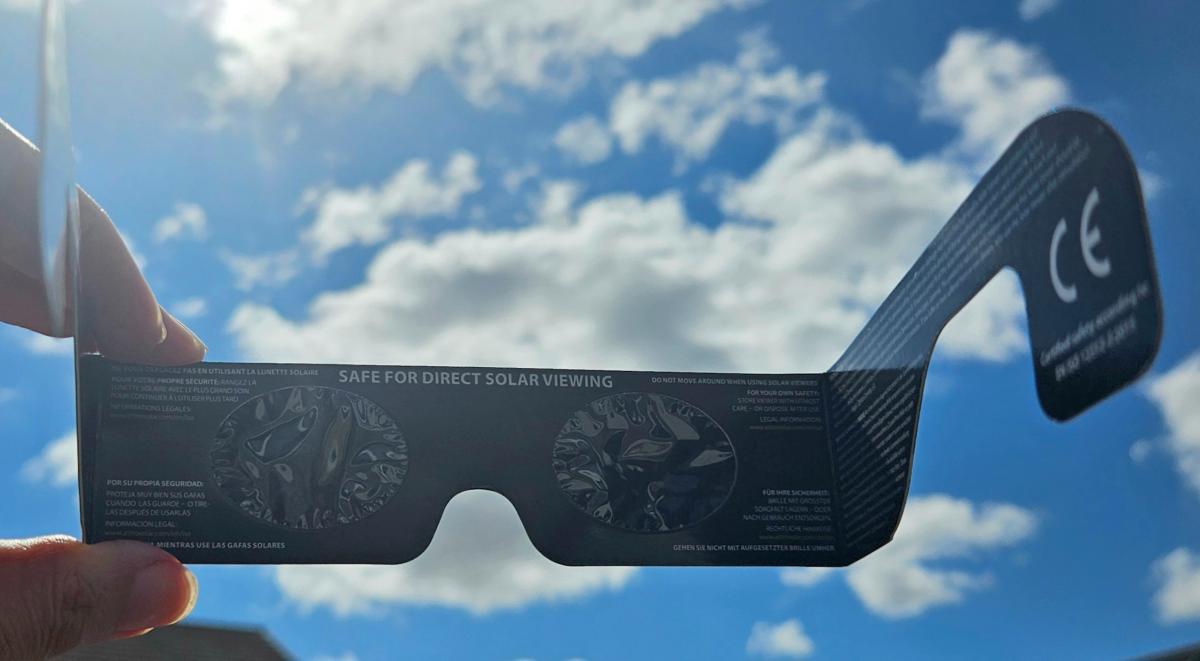
Watch safely and do not view the sun directly in this UK partial eclipse. Also don't take direct videos, your mobile phone can not cope, nor can your eyes.
So far much of mainland Spain is look clear, sunny and very hot. The same for Balearic Islands including Ibiza, Mallorca and Menorca. Iceland is looking very cloudy with perhaps a few lucky gaps in the west. In NE Portugal, the Montesinho Natural Park looks favourable but there is some low cloud on the charts.
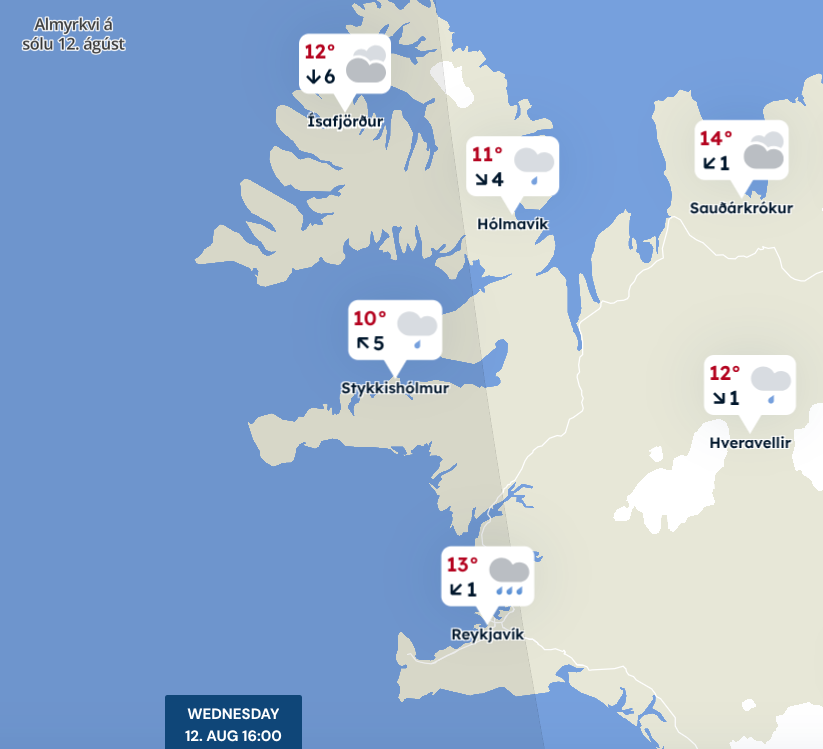
Iceland -Totality will be around 17:45 to 17:48 for western Iceland with up one to two minutes at 100%. Local time is the same as GMT. The Icelandic Met Service (Vedur) have a specific Eclipse section on their website.

Forecast 10/08/26 for Weather outlook along the path of totality
“Capital area Rekjavik- Rather light easterly or northeasterly winds, cloudy with rain. There is little chance of breaks developing in the cloud cover around the time of the solar eclipse."
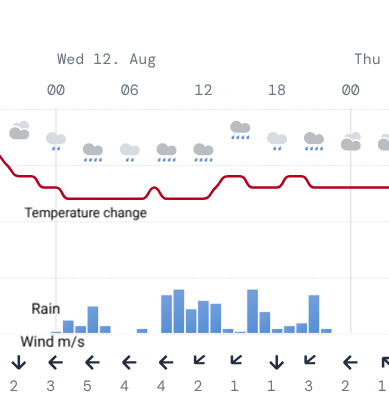
Outlook for the capital Reyjavik on Wednesday 10th
"Reykjanes Peninsula -Similar conditions are forecast for the Reykjanes Peninsula, with northeasterly winds and rain. There is little chance of breaks developing in the cloud cover.” Snæfellsnes Peninsula and Westfjords perhaps offer a little hope.
There are specific cloud cover charts. It shows low and medium level cloud combined with green showing lots of cloud and white showing potential gaps or clear skies. In the end, if you are on Iceland for the eclipse you may just have to hold out for a lucky gap.
Spain - AEMET, the Spanish Met service, has a special written forecast
‘during the afternoon, convective clouds will form over the northern mountains and the eastern third of the peninsula, potentially interfering with the view of the eclipse in some areas.’ ‘cloudy or overcast skies with low-level clouds are expected in parts of the Cantabrian region and northern Galicia, particularly along the coast’
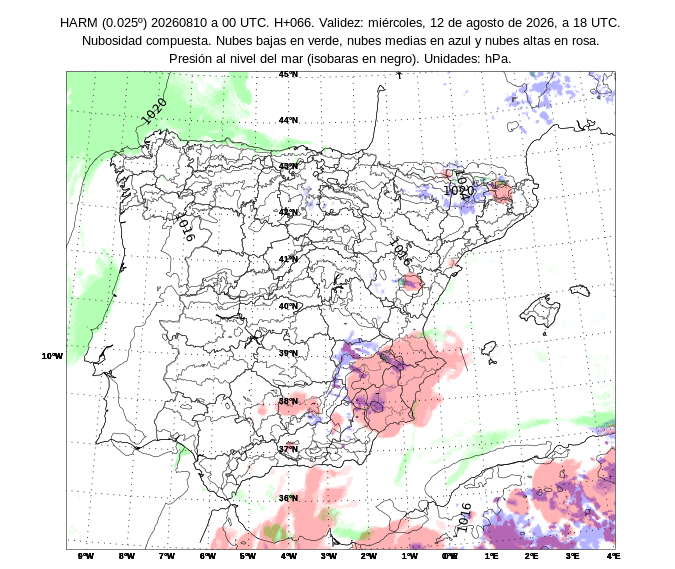
‘Shown [above] are the forecast low [green], mid-level, and high-level cloud cover and the probability of clear skies for 20:00 (Peninsular time)—approximately half an hour before the eclipse reaches its peak…note that red[pink] shades on the map indicate a very high likelihood of partly cloudy or clear skies—meaning an absence of cloud cover. It should be noted that high-level clouds generally do not prevent the eclipse from being observed. Furthermore, at the time of the eclipse, the sun will be low on the horizon; consequently, any cloud cover that might interfere with viewing would be located to the west and slightly to the north of the observation area, potentially even at a considerable distance from the observer.’
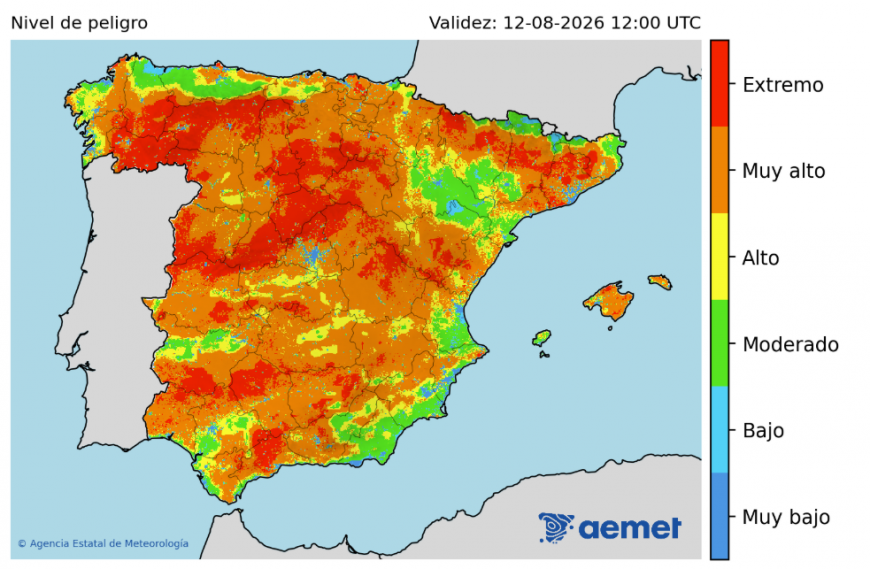
For those travelling the fire risk is very high [alto] to extreme in places.
Balearics - the cloud charts are showing areas of low cloud [green] to the north over the sea but currently the forecast looks fine and clear and hot for the islands.
Portugal - The total eclipse will only be 26 seconds in northeast Portugal, over a minute shorter than some parts of inland northern Spain. The peak will occur around 19:30 local time. There is already a yellow heat warning from IPMA, the Portuguese Met Service with temperatures well into the 30s Celsius. Skies are expected to be clear in the 100% zone but other coastal areas could see some low cloud, perhaps south of Porto for western central areas.
“The last total solar eclipse visible from mainland Portugal took place more than a century ago, in 1912, and the next one after the eclipse of 12 August is not expected until 2144, more than a hundred years from now.” Ciencias, University of Lisbon
More Solar Eclipse chat on the Netweather community forum.
Loading recent activity...