


Until this month, the previous UK temperature record had been 32.8C, set at Horsham, Tunbridge Wells and Regents Park in 1944. This was beaten by a full 2C on 25 May 2026, with 34.8C recorded at Kew Gardens, London. The record was extended further on 26 May 2026 with a maximum of 35.1C at Kew Gardens. According to TORRO, date records were also set on 24, 27 and 28 May 2026, although on each occasion they did not reach 32.8C.
Record temperatures were also smashed in Wales, where the previous record had been 30.6C at Newport on 29 May 1944. During the recent hot spell, Cardiff Bute Park recorded a maximum of 32.9C. For Scotland and Northern Ireland the spell has been less exceptional, as some cooler air moved in during the preceding weekend and into early last week via a westerly flow. However, as with many recent hot spells, the heat extended a long way northwards up the eastern side of England. For example, according to the Met Office, Durham set a new May temperature record of 29.7C, and Morpeth Cockle Park set a new May temperature record of 27.7C.
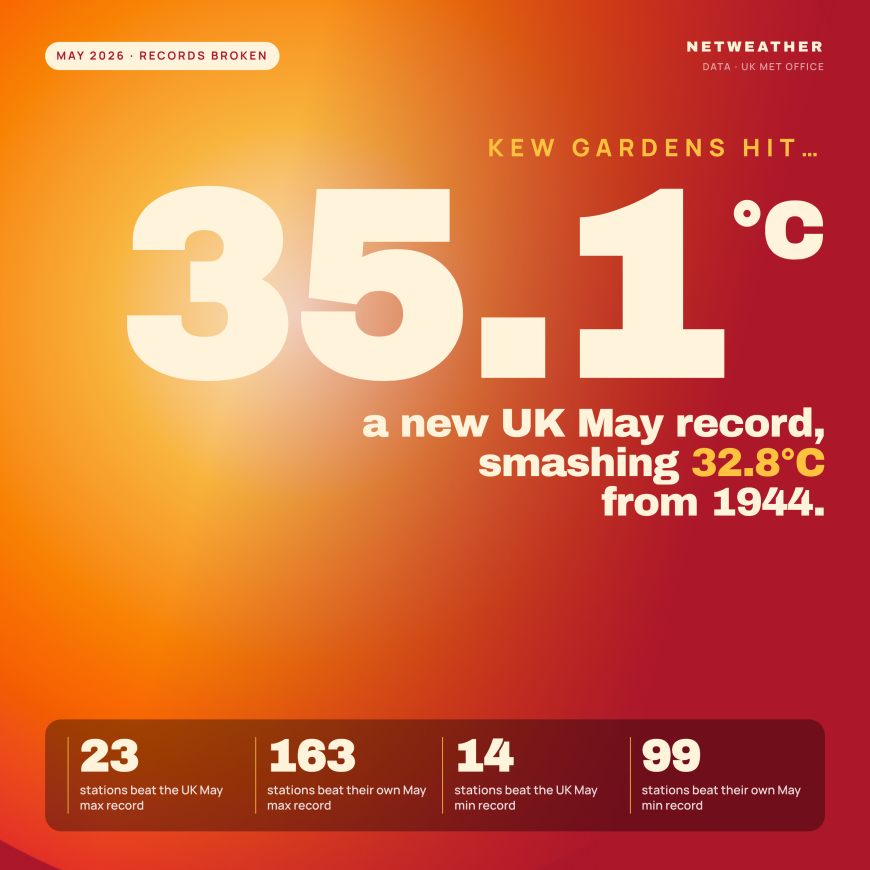
Usually spring hot spells see relatively cool nights which makes cooling down at night easier than in high summer, but there were some unusually warm nights during last week's spell as well. Record high overnight minimum temperatures included 21.4C at Camborne (Cornwall), 21.3C at Kenley Airfield (London) and 20.9C at Emley Moor (West Yorkshire), which beat the previous May record temperatures by between 4 and 6C. The minimum temperatures, while less headline grabbing than the daytime maxima, tend to be especially responsible for heat-related mortality. There were also record high minimum temperatures in parts of Scotland.
The May heatwave also contrasted with a spell of cool weather earlier in May 2026, when northerly winds blew frequently and temperatures were widely 4 to 6C down on the 1991-2020 long-term average. Some regions saw temperatures around 15 to 20C higher than a week earlier.
June has come very close to setting new UK record temperatures in recent years, but at present the June temperature record is still the 35.6C at Southampton Mayflower Park on 28 June 1976. This was during an exceptional hot spell for the time, when southerly winds around 22-24 June 1976 were followed by a build of high pressure, and temperatures well into the 30s Celsius persisted well into early July.
The new May 2026 temperature record was just 0.5C short of the June record. Some sites in England and Wales, again including Camborne in Cornwall, beat their June record temperatures by a fair margin in May 2026. This underlines the fact that the June 1976 record is looking vulnerable. There were a few occasions when June 2025 looked likely to break the record, but on each occasion cooler arrived just in time to keep the temperatures short of the record. June 2019 also came close, with record temperatures at the 850 hPa level (about 1500m above the surface), but the surface fell short of breaking the record.
Generally, heat "spikes" are becoming more common in Britain, especially the east of England, and over much of Europe as a whole. Heat tends to build more quickly and intensely between May and September than was the case in previous summers. I get a sense that this shift especially kickstarted around 2015, which saw a record breaking hot August in southern Europe and a marked heat spike in parts of Britain on 1 July, when Heathrow Airport (London) soared to 36.7C from what was quite a brief southerly.
It may not be coincidental that it was around 2015-16 that global temperature jumped upwards by 0.2-0.3C during an El Nino, following a period of relatively slow warming between around 1995 and 2014, when global temperatures only rose by a similar amount during that 20-year period. After a period of rapid global warming in the 1980s and early 1990s, and a reduced rate of warming between the late 1990s and early 2010s, the past decade has returned to seeing rapid warming globally.
The first third of June 2026 looks set to be somewhat cooler and more changeable, with predominantly westerly and south-westerly winds. Temperatures will start off on the warm side, especially in eastern Britain, but for much of the period they will probably come out close to or just below the 1991-2020 long-term normal. This wetter weather follows the El Nino year analogues which saw wet Junes in 1966, 1982 and 1997, although the first two of those Junes were rather warm.
However, it looks like there is a substantial chance of June 2026 deviating from those analogues as we approach midmonth. The ECMWF 42-day forecast model has persistently been forecasting a build of high pressure towards mid-June 2026, and this is now starting to appear on the GFS and ECMWF operational model runs starting at around 10 June. This is likely to result in further hot dry sunny weather for much of the country.
There are also similarities between this forecast and how June 2025 panned out, it was changeable and fairly cool early in the month but after the first week it soon turned very warm.
Loading recent activity...