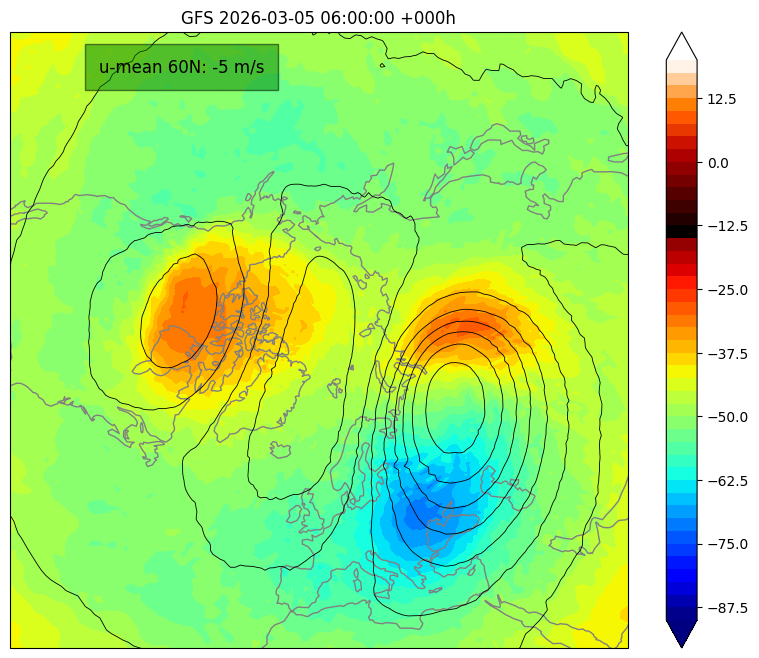



A major Sudden Stratospheric Warming (SSW) event, with a reversal of winds at 10 hPa 60N, occurred yesterday, with a weakening and split of the stratospheric polar vortex during this week. These events sometimes extend into the troposphere, where our weather happens, and can result in a robust negative phase of the Arctic Oscillation (AO), allowing cold, arctic airmasses to invade the mid-latitudes.
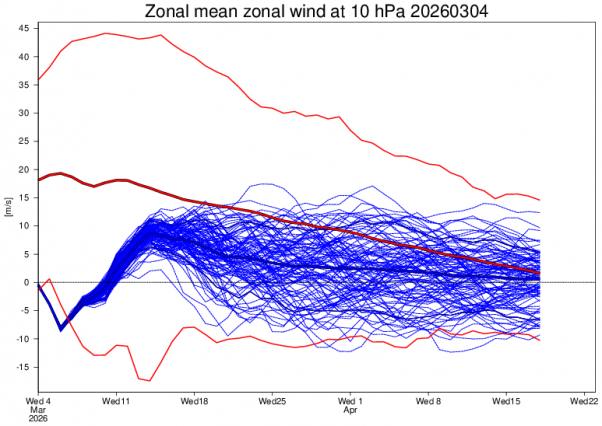
However, dynamical model guidance currently suggests the event may by slow to extend down into the troposphere, where our weather happens, with impacts on weather patterns from the SSW not until later this month, with the Arctic Oscillation (AO) & North Atlantic Oscillation (NAO) forecast to stay positive from now until beyond mid-month.
The polar vortex, which is a robust stratospheric circulation always above the pole in the winter half of the year, has shown a weaker intensity this season. The significant disruption of the polar vortex over the Arctic now is due to the penetration of warmer air into the polar stratosphere, hence why it’s named a major sudden stratospheric warming (SSW), which will cause the polar vortex to split.
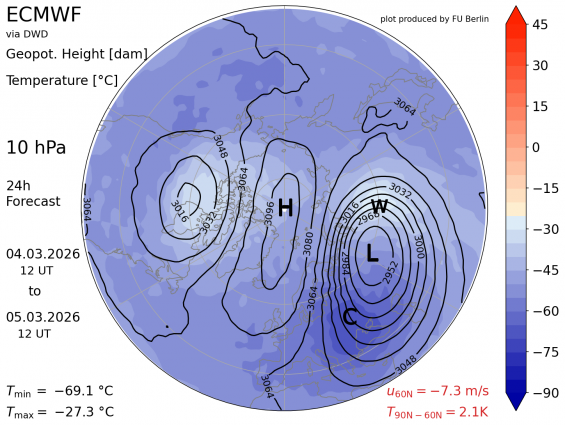
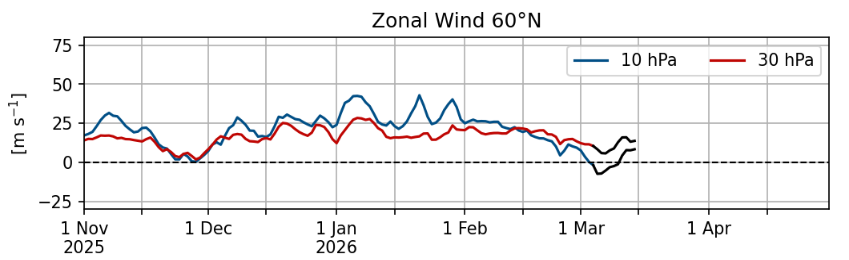
In the middle stratosphere (around 10 hPa, ~30 km high), the zonal mean zonal winds at 60°N have reversed from their westerly direction to easterly, thus fulfilling the formal criterion for a major SSW, as illustrated by the diagram below showing transition from positive to negative winds (below 0 m/s). This event involves not only a weakening of winds in the mid to upper stratosphere, but also a complete breakup of the vortex into two separate vortices.
Reversal of winds at 10 hPa 60N
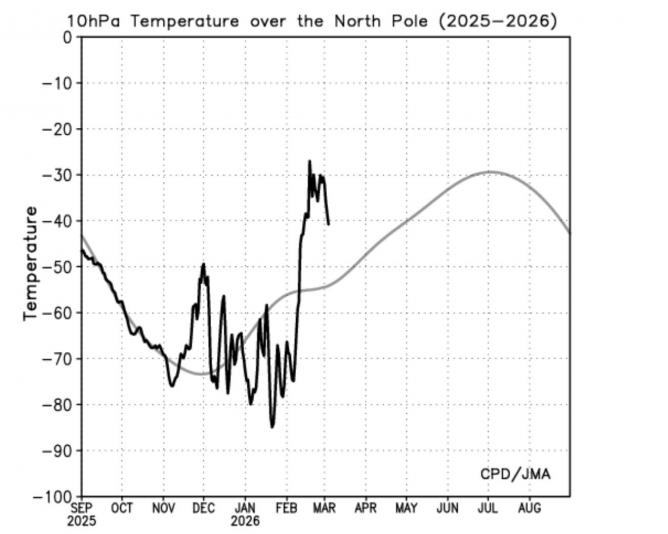
The mechanism of a SSW is an increased propagation of planetary (Rossby) waves from the troposphere to the stratosphere. These waves slow down the westerly circulation over the pole and disrupt the polar vortex. As wave activity increases, the vortex increasingly shifts and elongates, and eventually may break up. Part of this process is also the reversal of stratospheric winds from westerly to easterly, while the planetary waves also transport warmer air from the troposphere to the stratosphere, leading the rapid warming over the Arctic in the stratosphere.
Temperature anomalies at 10 hPa 60N show strong warming over the Arctic in early March.
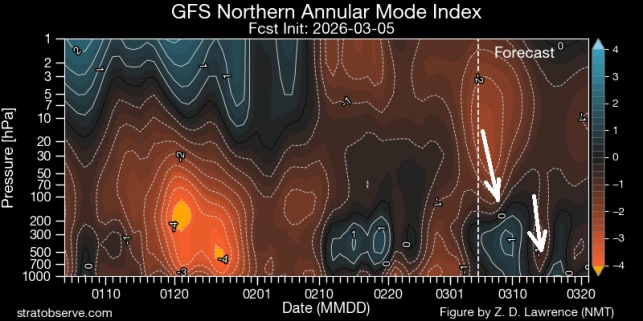
The breakdown of the polar vortex can influence the weather, sometimes within a few weeks, but often with a delay of several weeks. Although this response does not occur in every case. Downward coupling following a major SSW can be understood as a gradual descent of circulation anomalies from the stratosphere into the troposphere. After a wind reversal in the upper stratosphere, easterly anomalies and associated increases in geopotential height propagate downward over days to weeks, causing the jet stream to slow down and meander in a north-south (meridional) pattern or shift much further south in track – which typically projects onto a negative AO/NAO pattern, favouring higher pressure over the Arctic and lower pressure in mid-latitudes. The resulting meridional flow weakens the zonal circulation, promotes high-latitude blocking (often over Greenland or Scandinavia) and increases the likelihood of cold Arctic or continental air advection into mid-latitudes of Europe and North America.
A look at the latest GFS forecasts for the vertical profile of the atmosphere suggests the reversal in the upper to middle stratosphere slowly ‘dripping’ down into the troposphere later this month.
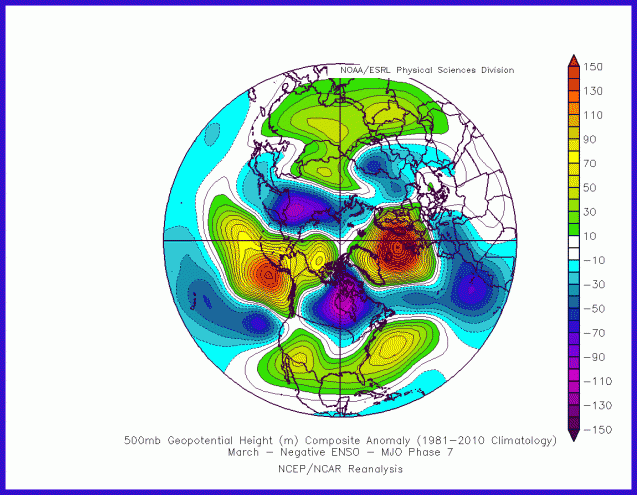
The potential downwelling of the reversal of winds in the stratosphere could combine with cycles of tropical forcing which can both favour high latitude blocking high pressure systems to develop. The tropical forcing in mind is the Madden Julian Oscillation (MJO). There are correlations that can be made between the 8 different phases of the MJO and the lagged impacts on the upper air patterns that might be expected over the North Atlantic and Europe based on composites of previous events. The MJO has weakened recently as it passed over the Maritime Continent (SE Asia islands) but is forecast to strengthen over Western Pacific next week in phase 7. There is a lag of around 10 days for each phase to have their own particular impact on mid-latitude weather patterns, a composite of Marches with phase 7 during La Nina, taking into account the lag response, indicates high latitude blocking affecting northern Europe.
The ECMWF sub-seasonal model does show a signal for high latitude high at the end of March and into early April, which could mean cooler / colder easterly winds developing around then. But unlike following the February 2018 SSW, we aren’t expecting the Beast from the East, IF blocking to the north develops to end the month.
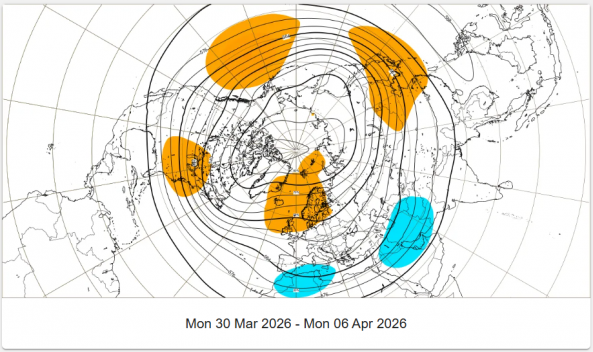
So even though it feels like May today across parts of England, temperatures reaching 18-19C in London area and East Anglia, there is potential that winter could bite back at the end of the month or even early April – the risk enhanced by the SSW at the moment. But it’s not a certainty.
Loading recent activity...