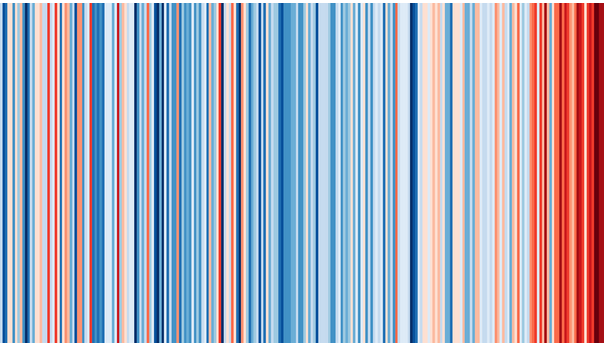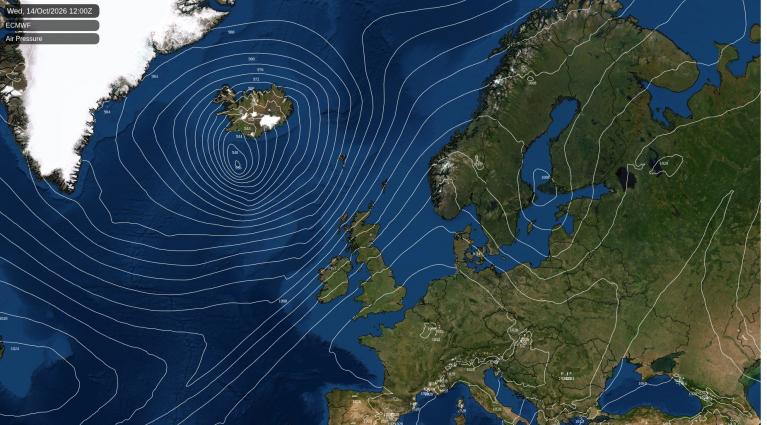



Annual temperatures in Vienna from 1775-2017. The colour scale goes from 7.5°C (dark blue) to 12.0°C (dark red) Warming Stripes
Forecast for the next ten years - It is likely that we will see the warmest year globally in the next five years. 2016 was the warmest year on record, 1.16C above pre-industrial levels. The IPCC talk about 1.5C and 2C levels of global warming, the Intergovernmental Panel on Climate Change. There is a 10% likelihood that the 1.5C level will be breached in the next 10 years, according to this new Met Office climate forecast.
The usual weather forecast looks five days ahead quite comfortably often with high confidence. Out to ten, trends can be gathered with still some detail, especially if pressure is building nearby. The Met Office issues their technical Contingency Planners forecast for three months ahead which gives a likelihood that the upcoming weather trends will fall into various categories. It does not tell you what the weather will be like in a certain location on say your birthday.
“For January and January-February-March as a whole, above-average temperatures are more likely than below-average temperatures. Impacts from cold weather remain possible, but they are less likely than normal. ”It is an indication of possible temperature and rainfall in a suite of forecasts designed for contingency planners. The outlook should not be used in isolation." That last bit is for newspapers who take one line and claim that a whole season will be hot/cold/wet etc.
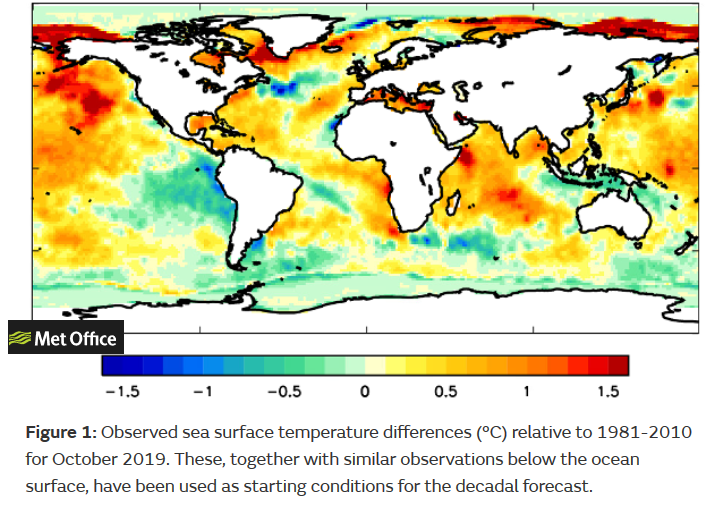
At the end of January 2020, the Met Office issued its Decadal Forecast which is also called ‘near-term’ climate predictions with a range up to ten years (a decade) ahead.
Weather forecasts and climate predictions. Weather is the day to day, short term changes extending to the next week or two. Changes in temperature, precipitation and winds, will it snow today, be hot this weekend etc.
Climate looks at the conditions of an area over a period of time. 30 years is often used for comparisons here in the UK, 1981-2010. Comparing back to 1850-1900 is often used in terms of pre-industrial temperature changes. Ice cores can tell us about climate from thousands, even hundreds of thousands of years ago. Climate is about longer term conditions and changes.
Our global climate is changing, warming rapidly. Governments and peoples have important, huge decisions to take and policies to implement. “
"Climate Change is the defining issue of our time and we are at a defining moment. From shifting weather patterns that threaten food production, to rising sea levels that increase the risk of catastrophic flooding, the impacts of climate change are global in scope and unprecedented in scale. Without drastic action today, adapting to these impacts in the future will be more difficult and costly.” UN
Temperature data exists of what is already going on and a new forecast has been issued by the UK Met Office this month. This Decadal Forecast “suggests that Earth’s global average temperature is likely to reach record warmth during the five-year period 2020-2024.” Met Office
These decadal forecasts are for a range of possible conditions over a wide area and time span. Not everywhere will warm, there are suggestions that the Southern Ocean stays cooler but “enhanced warming is likely over much of the globe, especially over land and at high northern latitudes”. MO
“The latest five-year forecast suggests continued warming, consistent with sustained high levels of greenhouse gases. “ Dr Doug Smith, Met Office expert on decadal prediction. Our human modern lives are enhancing these high levels. He says that “Uncertainties exist within the forecast”
“The Met Office Hadley Centre has been recording global temperature data for more than 160 years. 2016 was the warmest individual year. In the absence of a major volcanic eruption, a new record is likely in the coming five years.”
Large volcanic eruptions can send huge amounts of aerosols up into our atmosphere and reduce the amount of sunlight globally. That is why eruptions are marked on temperatures graphs such as the Ed Hawkins tweet above. The Kuwae eruption was one of the largest in the last 10,000 years, Vanuatu Islands, Pacific.
The information release from the Met Office about their long term forecast also mentions:
AMO – “The Atlantic Multi-decadal Oscillation (AMO) has been identified as a coherent mode of natural variability occurring in the North Atlantic Ocean with an estimated period of 60-80 years. It is based upon the average anomalies of sea surface temperatures (SST).” Associated with important climate impacts, such as the multidecadal variability of Atlantic Hurricane activity, North American and European summer climate, northern hemispheric mean surface temperature, and Arctic sea ice anomalies”. The Climate Data Guide
PDO – “The Pacific Decadal Oscillation (PDO) similar in the North Pacific basin. “Associated with societally relevant impacts on precipitation, temperature, snowpack, and drought, especially in western North America. The PDO is decadal in scale. “
This is a forecast from a world-renown source on how our climate is likely to continue to warm at an unnatural rate. There is plenty of technical data to reference, the warming stripes were made to give a clear graphical image of what was going on and on Twitter, there are updates about weather records falling every month, sometimes each week.
Although individual weeks/ seasons/ or a year can’t be taken as evidence on their own, the overall impression is piercing.
“Summary: The impacts of climate change are being felt in every inhabited continent and in the oceans. However, they are not spread uniformly across the globe, and different parts of the world experience impacts differently. An average warming of 1.5°C across the whole globe raises the risk of heatwaves and heavy rainfall events, amongst many other potential impacts.” IPCC
Loading recent activity...