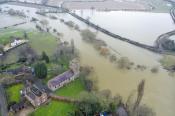



Parts of Wales are heading for a Hosepipe Ban this weekend as the summer holiday season begins. Numerous water companies in England already have restrictions in place, a TUB. What do these Temporary Usage Bans cover, what can you do and not do? Research commissioned by the Environment Agency in England tried to find out about people's understanding and reflections on these 'Hosepipe Bans'.
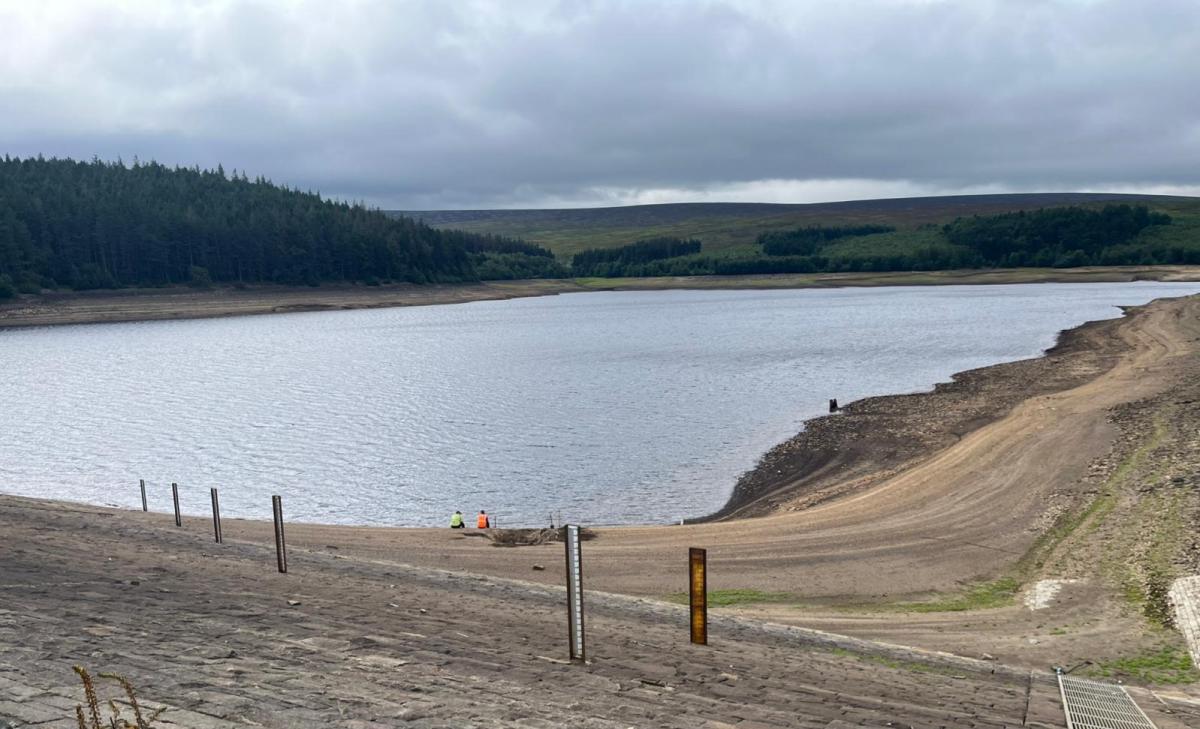
Welsh Water “It is likely that a ‘hosepipe ban’ will be introduced this weekend (18th/19th July) ... unless exceptionally high water demand reduces… Unlike the short-lived peaks normally experienced during warm weather, demand has remained exceptionally high throughout the day and into the evening for several weeks… Increased numbers of holiday makers and visitors to the area as the summer holiday season begins are expected to add further pressure to the local network.”
The official term is a TUB, a temporary usage ban, but this has gained little traction against the familiar “Hosepipe ban”. However the term does present difficulties, so much that the Environment Agency in England commissioned research on public perceptions and attitudes towards temporary use bans (TUBs) during droughts and periods of hot weather.
The main goal was “to better understand how people view these restrictions, what makes them feel acceptable, how they relate to keeping the water supply reliable and to protecting the environment, and to explore effective communication strategies for engaging the public about these measures.”
The research engaged 2,100 adults in England via an online survey. They were identified by age, sex/gender, access to an outdoor space, and previous experience of a TUB.
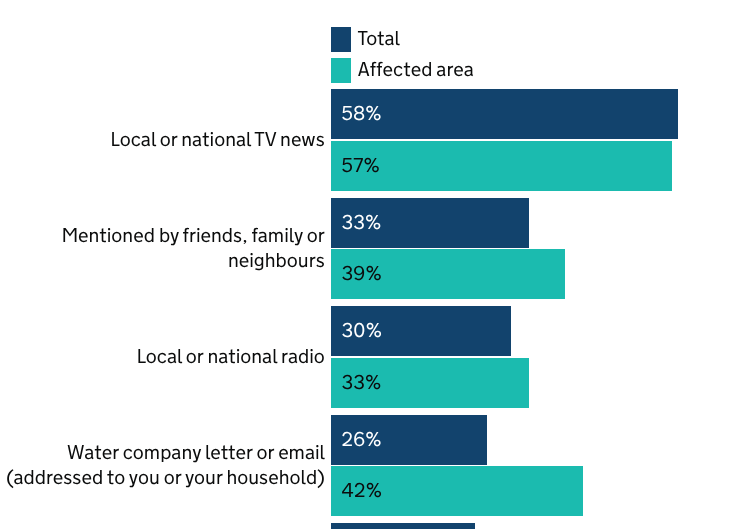
From which sources have you heard about hosepipe bans/TUBs? All respondents aware of TUBs (2,011); All in affected areas aware of TUBs (553)
Some of the findings
Support for hosepipe bans can be strong but trust in the communications is very important. Who the message is coming from and where it was seen but also it needed a good explanation, a clear rationale. Visual updates were considered important, about why now and what should you do.
Seeing low reservoirs or encountering a heatwave raised support. Restricting non-essential practices was often highlighted, that watering sports fields and golf courses, ornamental fountain usage should be reduced first. Businesses carrying on as normal whilst residential households had to adjust was unpopular.
Distrust of water companies often worked as barrier, that they weren’t fixing leaks or investing in the infrastructure so why should customers adjust their behaviour. Although water companies were often clear about the start of TUBs, people felt that the end of bans was often unclear or quieter. This added to distrust.
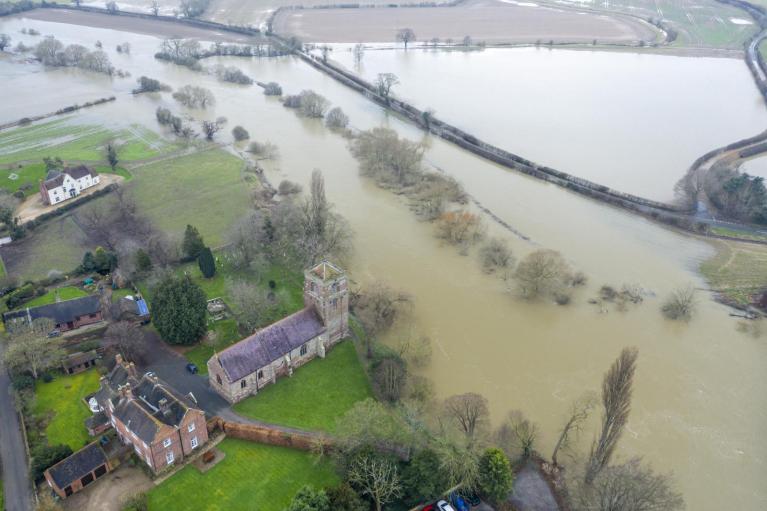
This also related to education and sharing of how things worked. People were less accepting of a TUB when it started raining again, often with little understanding of how the water systems worked, and recovered. There was frustration that a TUB would last too long.
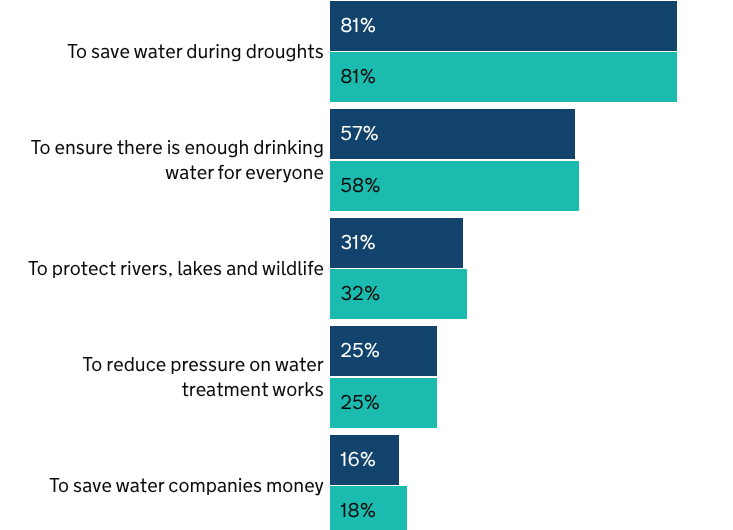
Why do you think hosepipe bans are introduced? All respondents (2,100); All in affected areas (564)
Those who had had experience of TUBs were more accepting of another one but more critical, about length of a TUB, more distrustful and critical of enforcement.
People said that they were happy to comply and make small behavioural changes such as turning off taps when brushing their teeth and having shorter showers. Some people had set up water butts or would use grey water to water the garden but they did not want to pay extra on their (already high) water bills for future investments and infrastructure. This again linked to distrust of the water companies. Reusing water and recycling it was slowly becoming more acceptable
Not many people knew about how the water companies could enforce a TUB and there were responses about if neighbours were using water, then they would. Overall older people, especially in rural settings were more aware and compliant, more supportive of TUBs. They wanted traditional notification; by letter or on the television.
Younger people, especially those in London, were least aware and looked for digital communications. Social media and customer emails were useful. They also were most unclear about the rules.
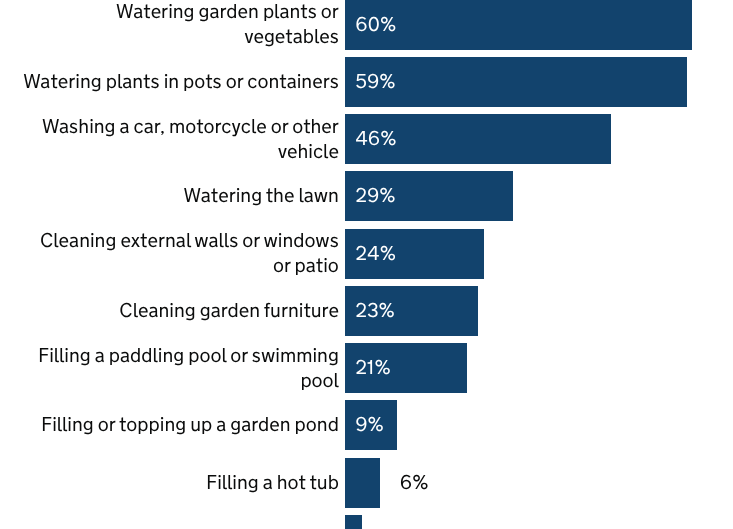
Which of the following activities do you use your hosepipe for? All respondents who have a hosepipe in their household (1,293)
OFWAT “A hosepipe ban (or a Temporary Use Ban to use its formal name) can be used by water companies when they are having to manage their supplies of water because there is high demand and lower supply” often after a long dry season, sometimes with an accompanying heatwave. There is still enough water to drink and wash with, but a hosepipe ban helps reduce demand for water; hosepipes use a lot and generally for non-essential purposes.”
As the name suggests, if a ban is in place where you live, you can’t use a hosepipe for things like watering your garden, filling a paddling pool or washing your car. No sprinklers or pressurewashers either. You can water plants outside with a watering can, just not the hosepipe. Just leave the the lawn, even though the grass may look brown and dead, it always recovers.
If you are found to break the rules, you could be fined up to £1,000. Enforcement information will be on your water companies website.
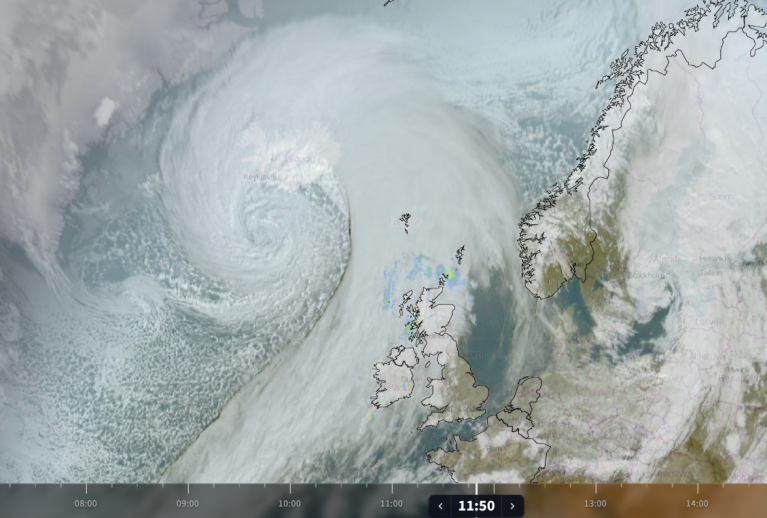
Water is a precious resource and we are using more of it. Planning decisions need to reflect our warming climate and the already vulnerable supply. England and Wales both experiencing their warmest spring in 2026. 2025 included the UK’s warmest spring and summer on record. In spring 2025, most of England and Wales received less than half of the 1991-2020 average rainfall, and in some places less than one third, England had its driest spring for over 100 years. (Met Office)
“Climate change has been described by scientists for many years but is now increasingly being felt by UK population in the own homes and communities.” Professor Liz Bentley- CE Royal Meteorological Society
Southeast Water “ Our absolute priority has to be making sure there is always enough water for everyone’s essential daily needs—like hygiene, drinking and cooking—and that we protect our vulnerable customers.”
What would help?
Practical guidance about reducing water use would be well received. Advice about what to do with swimming pools and hot tubs in terms of topping up and maintaining rather than refilling under a ban. Better explanation of why rainfall doesn’t solve the issue and that would need to be a visual answer, not just lengthy text. The overall picture of different water users such as farmers, safeguarding essential supplies, what is needed for environmental protection and the levels of restrictions for households.
In Wales and Scotland, our mains water originates as surface water, in reservoirs or taken from rivers not groundwater supplies. Understanding the overall picture might help people of different ages respond more positively to the TUBs.
If the conditions continue and the water saving efforts don’t gather momentum, the next stage is a non-essential use ban or NEUB. A NEUB is a more serious step that water companies can take if dry conditions continue after a hosepipe ban has been introduced. While hosepipe bans mainly affect households, NEUBs specifically target businesses. Businesses use around a third of all water supplied in the UK, so restrictions on commercial water use can make a significant difference to overall demand.
If a NEUB is put in place, businesses must stop using water for activities such as filling or maintaining a non-domestic swimming pool or paddling pool, operating a mechanical vehicle washer and cleaning windows.
As Anglian Water say “Love every drop".
Environment Agency research and analysis July 2026
Loading recent activity...