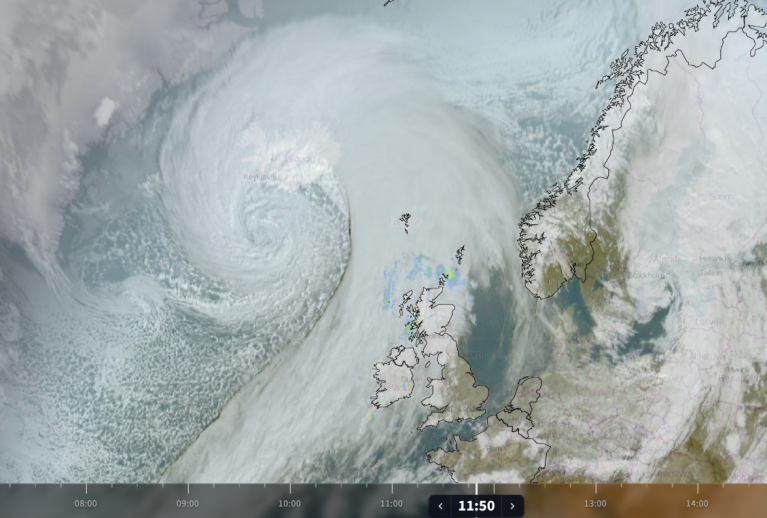



The weather over Britain is currently relatively cool and showery, although I get a sense that the current weather setup might have brought wintry showers to low levels in the north, and maybe locally in the south as well, had it happened a few decades ago. In the 1980s and 1990s it was not uncommon to get wintry showers off this sort of polar maritime west to north-westerly in March, although lying snow tended to be restricted to high ground unless a particularly large scoop of cold air came our way from Greenland and Canada. A subtle impact of the warming climate has been that some snow events of the past have been turned into upland snow events, mainly above about 200m. In Scotland the snow line, in terms of lying snow, has been widely reported as being around 300m.
Sunday will be a being a windy day with a band of rain spreading eastwards through the country, followed by brighter, showery weather. But the main interest is in a plume of warm air which will head in from the south especially through Tuesday and Wednesday. It will primarily be an England and Wales event, and much of Scotland and Northern Ireland will miss the unusual daytime warmth, although temperatures will still end up a few degrees above the long-term average. The warmth is forecast to peak on Wednesday, when large areas of England and into east Wales will reach the high teens Celsius, and we may see somewhere nudge 20 or 21C, which would make it the warmest day of the year so far. The warmth also looks set to be accompanied by sunshine, especially in the eastern half of England.
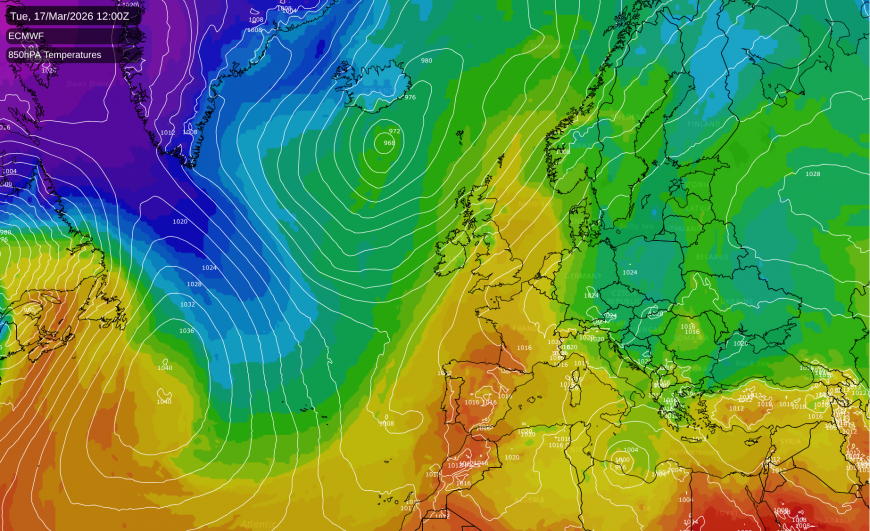
After that, we look set to pick up a cooler easterly flow. It will be no "Beast from the East" as per the two very cold easterly outbreaks in March 2018, as the easterlies will be coming in from central and eastern Europe, where it won't be particularly cold for the time of year, but it will bring a general drop in temperature, especially in eastern Britain, where daytime maximum temperatures may fall to around 8 to 10C in about a week's time. Such fluctuating temperatures are quite typical at this time of year, when the land masses are warming up and solar heating is increasing, but the Arctic typically remains relatively cold.
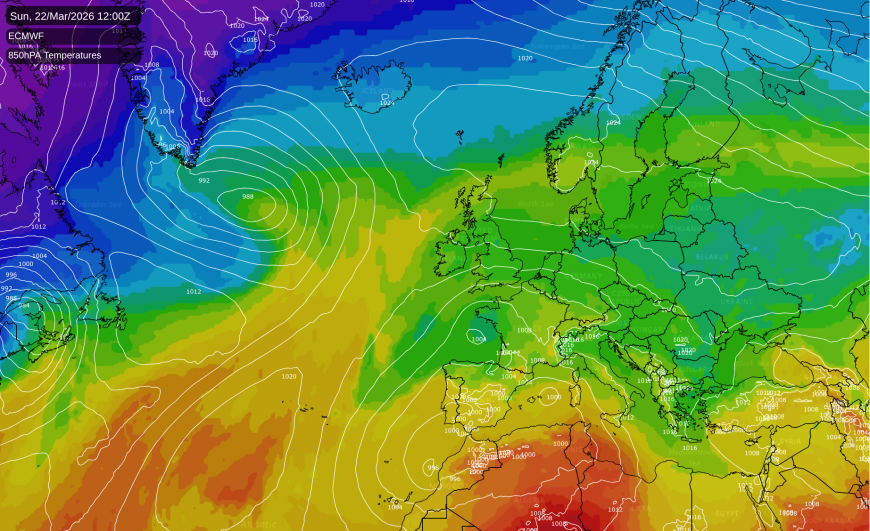
There is some potential for colder northerly or north-easterly winds to arrive in late March or into early April, with highest pressure moving to the north-west of Britain, which could produce issues with late frosts, but this is uncertain and a long way off.
According to data from the National Snow and Ice Data Center (NSIDC), it is a while since the Arctic sea ice extent set a record low minimum in the summer, after having happened repeatedly in 1990, 1995, 1999, 2002, 2005, 2007 and 2012. However, record lows have recently been set during winter and early spring. The Arctic sea ice extent has been close to record low since November 2025, and has recently been running second lowest on record, behind only 2025. Normally there would be some further growth during February and in some years Arctic sea ice extent has grown in early March as well, but in 2026 the Arctic sea ice extent has flatlined in February and early March. Temperatures in the Arctic are forecast to be generally above the 1991-2020 long-term average during the coming week, substantially so in some regions, so it looks unlikely that the Arctic sea ice extent will recover substantially in the coming week.
In contrast, the Antarctic sea ice extent is currently running just a little below average, after having got very close to the long-term average during February. This means that the summer minimum Antarctic sea ice extent is looking set to be the highest since 2021, after four consecutive years of exceptional lows. This is not necessarily a sign of long-term recovery, as there was a period of near average Antarctic sea ice extent in the early winter of 2024/25, before the sea ice extent then returned to being exceptionally low through February and March 2025. But there is a general sense that, so far, while the Arctic sea ice extent has been consistently well below the long-term average, the Antarctic sea ice extent is still more variable, though it is a number of years since it was last substantially above the long-term average.
Loading recent activity...